

The best diabetes doctor in Ahmedabad for you is not the one with the most impressive title or the longest waiting list — it is the one who consistently monitors your HbA1c, adjusts your treatment as numbers shift, explains your condition in plain language, and stays with you through every stage of the disease. Diabetes is a long-term condition. The doctor managing it needs to be more than capable at a single consultation. They need to be the right long-term partner for your specific situation.
This guide gives you 10 concrete factors to evaluate when choosing a diabetes specialist in Ahmedabad—so your decision is based on what genuinely produces better health outcomes, not reputation alone.
How to Choose the Best Diabetes Doctor in Ahmedabad: 10 Factors That Actually Matter
1. Qualification and Training in Diabetology
The foundation matters. A physician managing diabetes should have postgraduate training in internal medicine, endocrinology, or general medicine with demonstrated experience in diabetology. In India, the relevant qualifications include MD Medicine, DNB, DM Endocrinology, or FRCP — combined with active clinical practice in diabetes management rather than just a certificate.
At Sangini Hospital in Satellite, Ahmedabad, Dr Tapan Shah — MD, Consultant Physician and Intensivist — and Dr Harsh Maniar — Internal Medicine and Clinical Research — bring postgraduate medical training directly applied to chronic disease management, including diabetes. Qualification is the starting point, not the endpoint, of the evaluation.
2. Experience Specifically With Diabetes Patients
General clinical experience and diabetes-specific experience are different things. A doctor who has managed hundreds of newly diagnosed patients, patients in remission, patients with complicated HbA1c trajectories, and patients dealing with comorbidities — hypertension, kidney disease, neuropathy — brings a depth of pattern recognition that no qualification alone confers.
Ask directly:
- How many diabetes patients do you currently manage?
- Do you see cases involving complications?
- How do you approach a patient whose HbA1c is not responding to first-line medication?
The answers reveal whether experience is real or claimed.
Sangini Hospital has managed diabetes care for patients across West Ahmedabad since 2008. The clinical team has seen the full range — from straightforward newly diagnosed cases to complex long-standing patients requiring medication restructuring.
3. Approach to Long-Term Monitoring
Diabetes management is not a single consultation. It is a sequence of monitored decisions made over years. The right diabetes specialist in Ahmedabad structures their practice around monitoring cycles — HbA1c every three months, kidney function annually, eye screening at least once a year, and foot examination at every visit.
A doctor who prescribes medication and schedules the next appointment in three months without a monitoring plan is managing symptoms. A doctor who maps your HbA1c trajectory over time, adjusts treatment proactively when trends shift, and tracks organ-specific risk is managing the disease.
Before committing to a diabetes doctor, ask what their monitoring protocol looks like over a full year. The answer tells you everything about how they think about long-term diabetes care.
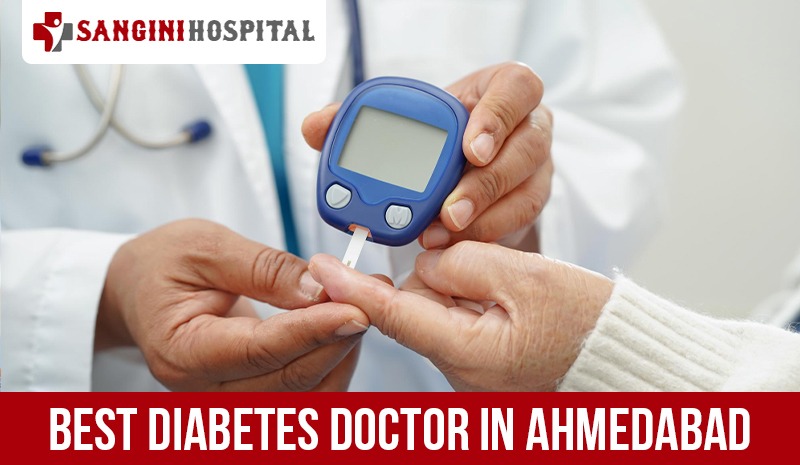
4. On-Site Diagnostic Availability
A diabetes consultation produces decisions — about medication, dose adjustment, and complication screening — that depend on accurate, current investigation results. If a doctor cannot access blood glucose, HbA1c, kidney function, and lipid panel results during or immediately after your visit, their clinical decisions are made on incomplete information.
Sangini Hospital in Satellite, Ahmedabad offers on-site diagnostics including ECG, blood panels, HbA1c testing, and kidney function screens within the same facility. The difference between accessing results during a consultation and receiving them days later from an external lab is not administrative — it affects the quality of every clinical decision made that day.
5. Availability and Continuity of Care
One of the most undervalued factors in diabetes management is seeing the same doctor consistently. A doctor who knows your baseline — your typical HbA1c range, your dietary patterns, your medication history, your occupational stress load — interprets a new result in context. A doctor seeing you for the first time at every appointment treats you as a new patient each time.
Look for a diabetes doctor in Ahmedabad who maintains their own patient list, tracks your records across visits, and is reachable between appointments when symptoms change. Continuity is not a convenience — it is a clinical advantage that produces better outcomes over time.
Sangini Hospital is open 24 hours, seven days a week. Emergency and acute consultation access is available at 079-40056171 — not just during scheduled appointment slots.
6. Diet and Lifestyle Integration
Medication manages blood sugar. Diet and lifestyle change the trajectory. The best diabetes doctors in Ahmedabad understand that both are necessary and neither replaces the other — and they either provide integrated dietary guidance or work closely with a dietitian who does.
An Indian diabetic patient eating Gujarati food needs advice calibrated to jowar roti, dal, rice portions, festival eating, and restaurant choices in Ahmedabad — not a Western dietary template. A doctor whose dietary advice is either absent or generic is leaving the most powerful tool in diabetes management largely unused.
At Sangini Hospital, dietary guidance is built into every diabetes management consultation — not offered as an optional add-on. The team has managed diabetes in the context of actual Ahmedabad eating patterns across more than 9,980 patients.
7. Complication Awareness and Screening
Type 2 diabetes damages the kidneys, eyes, nerves, and cardiovascular system silently over years. A diabetes specialist who manages blood sugar numbers without actively screening for these complications is addressing only part of the disease.
The minimum annual complication screening a well-managed diabetes patient should receive includes:
- Kidney function — serum creatinine and urine microalbumin to detect early diabetic nephropathy
- Eye examination — fundus photography or ophthalmologist referral to screen for diabetic retinopathy
- Foot examination — neurological and vascular assessment at every visit to detect early peripheral neuropathy
- Lipid panel and blood pressure — cardiovascular risk management alongside blood sugar control
- ECG — cardiac screening, particularly relevant in patients over 40 with longstanding diabetes
A diabetes doctor who offers or coordinates all of these as part of their standard annual protocol is managing diabetes comprehensively. One who does not is managing a number, not a patient.
8. Involvement in Clinical Research
A diabetes specialist engaged in clinical research stays current with evolving evidence. Newer drug classes — SGLT2 inhibitors, GLP-1 receptor agonists — have transformed diabetes management in the last decade and offer benefits beyond glucose control, including cardiovascular and kidney protection. A doctor not current with these developments may continue prescribing older protocols when better-evidenced alternatives exist.
Dr Harsh Maniar at Sangini Hospital works in clinical research alongside internal medicine practice. This combination — active research engagement alongside patient care — means the clinical approach at Sangini Hospital reflects current evidence rather than the standard of care from ten years ago.
9. Patient Communication Style
The most accurate diagnosis means nothing if the patient does not understand it. A diabetes doctor who explains HbA1c in plain terms, discusses why a medication is being added or changed, answers questions without hurrying, and gives written instructions the patient can refer to at home produces better outcomes than one who does not.
Patient reviews of Sangini Hospital consistently note that Dr Tapan Shah explains findings clearly, takes time with each patient, and gives practical guidance rather than generic instructions. This communication quality is not a soft factor — it directly determines whether a patient follows through on dietary changes, takes medication correctly, and returns for follow-up rather than dropping out of care.
10. Location and Accessibility in Ahmedabad
Managing diabetes well requires regular appointments, follow-up investigations, and sometimes unscheduled visits when symptoms change. A diabetes specialist in a distant part of Ahmedabad — requiring 40 minutes of traffic to reach — reduces the likelihood that those visits happen consistently.
For families in Satellite, Prahlad Nagar, Bodakdev, Thaltej, and surrounding west Ahmedabad areas, Sangini Hospital’s location on the 1st Floor, Santorini Square, Satellite, Ahmedabad, is directly accessible. The hospital’s 24×7 operation means an unscheduled visit — for an unexpectedly low reading, a concerning symptom, or a question that cannot wait — is always possible.
Proximity to your diabetes specialist is not a minor consideration. It is a factor that determines whether long-term care remains consistent or gradually lapses.
Putting It Together — What to Look For at Your First Appointment
When you visit a diabetes specialist for the first time, these are the signals that confirm you have found the right one:
- They review your full history before prescribing anything
- They explain your HbA1c and what it means for your specific risk level
- They outline a monitoring plan for the next 12 months, not just the next visit
- They ask about your diet, occupation, and daily routine — not just your symptoms
- They tell you exactly what complication screening you need and when
- They give you a way to reach them if something changes before your next appointment
Book an appointment at Sangini Hospital in Satellite, Ahmedabad to begin that first consultation — and to find out what consistent, properly structured diabetes care actually looks like in practice.
Frequently Asked Questions
What is the difference between a diabetologist and a general physician for diabetes care?
A diabetologist specialises exclusively in diabetes and endocrine conditions. A general physician or internist with strong diabetes experience manages the full metabolic picture — diabetes alongside blood pressure, kidney function, and cardiovascular risk — which is often more relevant for long-term diabetes management than a narrower specialist focus. Both are appropriate; the depth of experience and monitoring commitment matter more than the title.
How often should I see my diabetes doctor in Ahmedabad?
Every three months for HbA1c review and medication assessment when diabetes is not at target. Every six months, when well-controlled and stable. At least annually for full complication screening, regardless of how well-managed the condition appears. More frequently when starting new medication, after hospitalisation, or when readings become unstable.
Can diabetes be managed well without seeing a specialist — just with a family doctor?
Mild, newly diagnosed Type 2 diabetes in a patient without complications can be managed by a well-trained general physician. As complexity increases — multiple medications, early signs of kidney or eye involvement, insulin initiation, recurrent hypoglycaemia — specialist involvement produces meaningfully better outcomes. The transition point is individual, but most patients with diabetes lasting more than five years benefit from specialist-level monitoring.
What investigations should my diabetes doctor order at every visit? At minimum: fasting or random blood glucose and a review of home readings. Every three months: HbA1c. Every six to twelve months: kidney function (creatinine, urine microalbumin), lipid panel, liver function if on certain medications. Annually: eye examination, foot neurological and vascular assessment, ECG. A doctor who orders only blood glucose at every visit is not managing diabetes comprehensively.
Is Sangini Hospital a good choice for diabetes care in Satellite, Ahmedabad?
Sangini Hospital in Satellite, Ahmedabad, has provided diabetes care since 2008 under Dr Tapan Shah and Dr Harsh Maniar — with on-site diagnostics, integrated dietary guidance, 24×7 availability, and a patient base of over 9,980 individuals. For families in West Ahmedabad, it offers accessible, continuous, and comprehensively structured diabetes management.
How do I know if my diabetes is being managed well enough?
HbA1c consistently below 7 percent (or the individualised target your doctor sets), blood pressure below 130/80, LDL cholesterol below 70 mg/dL in high-risk patients, no new symptoms of neuropathy or vision change, and kidney function stable year on year — these are the markers of well-managed diabetes. If any of these are not being monitored regularly by your current doctor, that is the signal to seek a second opinion.
The Right Doctor Changes the Trajectory — Not Just the Number
Most people with Type 2 diabetes measure success by their fasting blood sugar. The right diabetes specialist measures it by HbA1c trends, complication screening results, medication appropriateness at each stage, and quality of life across years. That broader view is what prevents the kidney damage, vision loss, and cardiovascular events that develop silently when diabetes management focuses only on the immediate number.
At Sangini Hospital in Satellite, Ahmedabad, Dr Tapan Shah and Dr Harsh Maniar provide exactly that — structured, monitored, long-term diabetes care for patients across West Ahmedabad.
Book your diabetes consultation today.
📍 Sangini Hospital — 1st Floor, Santorini Square, Satellite, Ahmedabad – 380015 📞 079-40056171 | 📧 support@sanginihospital.com
https://addlinks.pro/D9syY